Join us fishing for plastic in Haarlem. Is 2026 your year to help us clean the city’s waterways?
Together, we can make the River Spaarne and Haarlem’s canals the cleanest in the Netherlands.
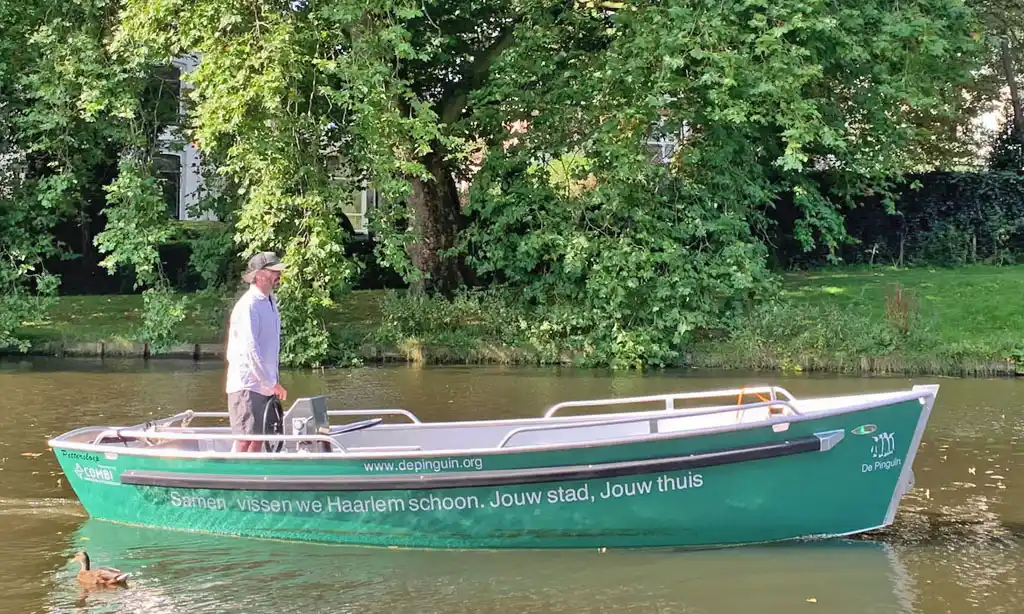
De Pinguïn (The Penguin) in Haarlem offers an unforgettable experience with a purpose.
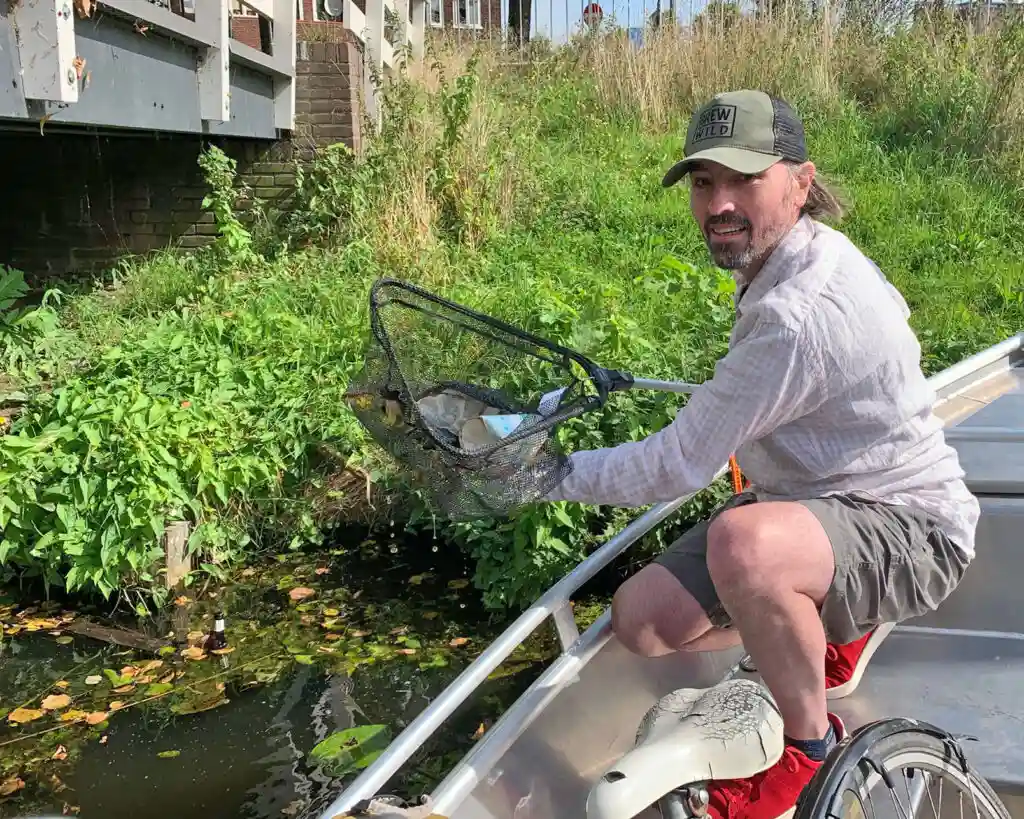
Therefore, give us just a couple of hours aboard our very special boat. Enjoy Haarlem’s sights and sounds while helping to remove plastic from the water.
So, why not visit Haarlem and make a difference. Join us for plastic fishing in Haarlem, North Holland.
What does plastic fishing cost?
The cost is your time, interest, enthusiasm and human capital.
But we also welcome donations. To do this, simply scan the QR code once you’re aboard.
Stichting De Pinguïn is a Dutch non-profit foundation dedicated to cleaning Haarlem’s waterways through practical community action.
How to book a seat for plastic fishing in Haarlem
Visit https://depinguin.org/vaar-mee/ to find a space on our regular Saturday afternoon sailing. Please note that this page is available only in Dutch.
Alternatively, you can also arrange an extra sailing on another day. Contact me about De Pinguïn. I am Peter, your native British English-speaking captain.
However, for large groups or corporate events, contact De Pinguïn through the website.
Why plastic fishing in Haarlem makes a difference
Haarlem’s waterways form the historic heart of our city. And everybody enjoys sharing them.
The river and canals are our playground. We sail and swim there. We relax beside the water and enjoy its beauty.
The water is our lifeline. Of course, we depend on it and nature depends on it.
And yet, we continue to pollute it.
An increasing amount of our plastic waste enters the water. It then flows into the North Sea and contributes to the harmful plastic soup.
That is not our intention, is it?
Keeping our nest clean
Penguins inspired Sander and Lenny to start this initiative.
With help from Haarlem’s enthusiastic and caring residents, we aim to keep our nest clean.
We remove plastic waste from the river and canals throughout the year. Everybody can join us aboard our electric sloop.
Together, through fishing for plastic in Haarlem, we can keep our waterways clean. We can protect them today and into the future.

A voluntary, hands-on activity
Peter’s involvement with Stichting De Pinguïn is voluntary and is not a paid professional or consultancy service provided by Matsuda Mulville. Joining Peter on the public community sailing described here is free of charge. However, voluntary donations to Stichting De Pinguïn are welcome and help support its work.
Moreover, Peter’s participation reflects the connection between the environmental values discussed on this website and the work undertaken locally. In other words, it is a small but tangible example of putting those values into practice: spending time on the water, working alongside other volunteers and helping to remove waste directly from the local environment.
The TrackJack experiment
Sooner or later, all waste in Haarlem’s water reaches the North Sea.
De Pinguïn conducted an experiment to demonstrate this. More information about the experiment is available through a Dutch-language link.
We released our TrackJack in Haarlem. This allowed everybody to follow the movement of waste from the city to the sea.
TrackJack floats on the surface. Undercurrents pull plastic waste beneath the surface and carry it faster.
Waste below the surface also avoids the effects of wind.
We needed TrackJack to remain on the surface so it could transmit its GPS signal. We therefore expected its journey to take longer than waste travelling below the surface.
Monitoring the experiment
We continually monitored the experiment.
We also removed every experimental resource from the water before it reached the North Sea.
Plastic Waste Diary
- Day 1 Our tracker is dropped in the water at Gravesteenbrug, Haarlem. The wind and the Heemstede pumping station pull it in a southerly direction.
- Day 2 Our tracker floats back towards Haarlem, eventually reaching Gravesteenbrug again and floating past.
- Day 3 The wind causes our tracker to float briefly in the Kloppersingel before it returns to the Spaarne, from where it is once again blown into the side canal near de oude oerkap / het milieuplein. Once the current has increased, our tracker quickly flows up the Spaarne towards Spaarndam.
- Day 4 Our tracker reaches Spaarndam overnight and floats near the Molenwerf before the Spaarndam pumping station is put into operation. Plastic usually continues its swift journey to the North Sea at this point, but our tracker is stuck behind the pumping station’s grates.
- Day 5 Our tracker is stuck in front of the pumping station, and we investigate. Plastic easily passes through the pumping station, so it is reasonable for us to move the tracker passed the pumping station. Unfortunately, we cannot find our tracker, so we patiently wait to see what happens next.
- Day 6 Our tracker’s GPS tracker suddenly reappears in the Boezemkanaal, meaning it has passed the pumping station without our help. By the end of the day it has reached the north of Het IJ at Spaarndam.
- Day 7 The Spaarndam pumping station is put into operation again, at which point the undercurrents sweep a lot of plastic towards the North Sea Canal. Our tracker appears to be too buoyant and is pushed southwards via the western side of Het IJ.
- Day 8 Our tracker remains floating in Het IJ at Spaarndam, on the south-western side. We suspect it is trapped by scaffolding somewhere, so we do not intervene because pumping operations begin again tomorrow, and we expect it to then continue its journey unaided.
- Day 9 Our tracker is most likely still bobbing under scaffolding west of Het IJ at Spaarndam.
- Day 10 Finally free, our tracker continues its journey! The previous day’s heavy rain and pumping operations allowed it to float to the north of the IJ at Spaarndam.
- Day 11 Our tracker has crossed the IJ at Spaarndam and got stuck in the reeds on the north side. It continues moving, a few metres at a time.
- Day 13 After a few days stuck in the reeds, our tracker is freed late in the evening, presumably dislodged a strong southerly current, sweeping it in the direction of zijkanaal C. By midnight, Our tracker is 100 metres upstream, back on its journey to the North Sea!